Industry News
 Home / News / Industry News / How Can Hot Stamping Foil For Building Material Reduce Production Time?
  2025.11.14
 Industry News
Across the construction and interior decoration industries, efficiency plays a vital role in maintaining competitiveness and meeting growing market demands. The use of Hot Stamping Foil For Building Material and Heat Resistant Hot Stamping Foil has become an increasingly practical solution for manufacturers who need both decorative and protective finishes without slowing down production. By replacing traditional coating and printing techniques with a faster, cleaner transfer process, hot stamping foil allows for significant time savings during surface decoration while maintaining consistent quality and design precision.
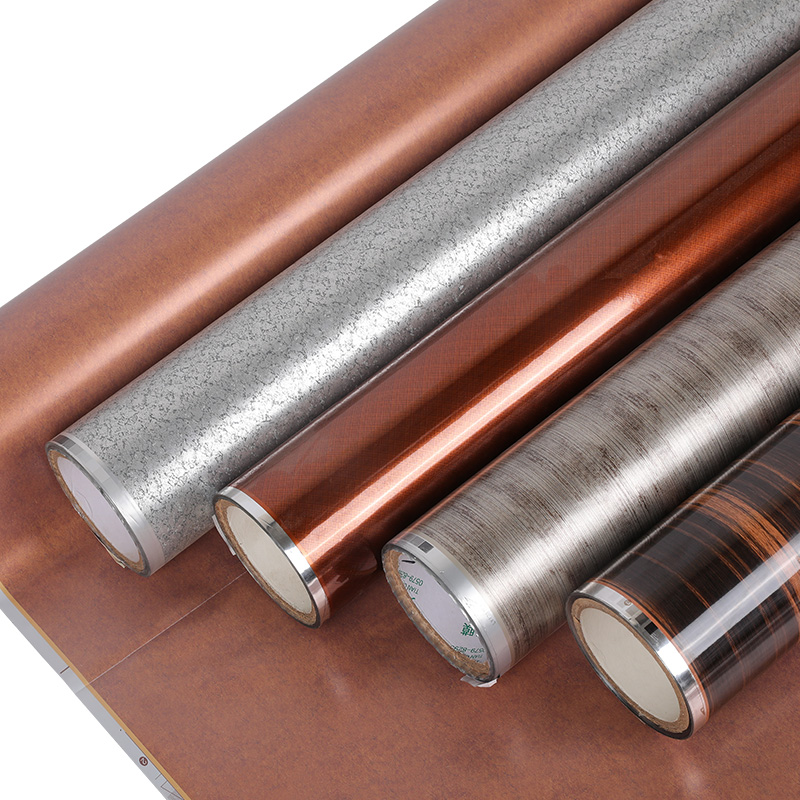
Conventional finishing methods such as spray painting or laminating typically involve multiple stages — surface preparation, primer application, drying, and sometimes repeated coating for color uniformity. Each step requires additional time, energy, and handling. Hot stamping foil, by contrast, transfers color and design in a single, heat-activated process. The PET carrier film, once pressed under controlled temperature and pressure, instantly bonds the decorative layer onto the substrate surface.
Because there is no need for drying or curing, the process eliminates waiting periods and reduces material waste. This dry transfer technology is particularly advantageous for manufacturers working with PVC, PS, WPC, MDF, or other plastic-based building materials. Production lines can continue running continuously without interruption, resulting in smoother workflow and reduced downtime between batches.
A key factor that slows down production in decorative surface manufacturing is quality inconsistency. Paint irregularities, color mismatch, or dust contamination can cause defects that require manual correction or complete reprocessing. Hot stamping foil significantly lowers these risks through its pre-defined color and pattern layers, which are applied directly through mechanical transfer rather than open-air spraying.
This process produces a uniform finish across all surfaces, maintaining consistent texture, gloss, and pattern precision. Because the foil’s design and pigment are sealed under a protective top layer, finished materials require less inspection and rework. This directly contributes to faster throughput and lower rejection rates. Additionally, the stability of Heat Resistant Hot Stamping Foil ensures that products maintain appearance even during post-processing steps such as cutting, bending, or assembly.
Another time-saving aspect of hot stamping foil technology lies in its equipment setup. Traditional coating lines often involve complex ventilation systems, drying tunnels, and solvent management units, each requiring regular maintenance and calibration. In contrast, hot stamping machines use controlled heat and pressure, enabling a cleaner and simpler configuration. Operators can switch designs or color foils quickly, which supports small-batch customization without long setup intervals.
This flexibility is valuable in today’s diverse building materials market, where demand frequently changes between finishes like wood grain, marble, or metallic effects. With adjustable temperature and speed settings, manufacturers can fine-tune the process according to material thickness and surface structure, keeping production both efficient and adaptable.
Automation has become a major trend in building material manufacturing. The design of Hot Stamping Foil For Building Material naturally aligns with automated systems because of its steady feed rate and predictable adhesion behavior. The film’s uniform thickness and mechanical strength allow continuous operation in automated transfer lines without frequent manual intervention.
This compatibility helps factories achieve higher productivity levels, particularly when handling large decorative panels or moldings. By integrating foil transfer into existing extrusion or molding processes, the overall production cycle can be shortened. For example, decorative finishes can be applied immediately after material forming, reducing the need for additional post-processing stations.
Energy consumption is another factor affecting total production time. Conventional coating lines require ovens or drying chambers that consume significant energy and increase operational costs. Hot stamping foil technology operates at controlled temperatures for a short duration, transferring the decorative layer almost instantly. This efficiency not only saves time but also supports more sustainable manufacturing practices by lowering overall energy demand.
Furthermore, the clean and solvent-free nature of the process reduces the need for frequent equipment cleaning or maintenance shutdowns. The absence of volatile organic compounds (VOCs) also contributes to a safer and more stable working environment, allowing continuous operation over longer shifts without additional air filtration requirements.

Contact Information
 +86-13665889229
 +86-0579-89123153
 Ditian Industrial Park, Xiaoshun Town, Jindong District, Jinhua City, Zhejiang, China.
Get in Touch
Copyright © Jinhua Zengcai Decoration Materials Co., Ltd. All Rights Reserved.
 Wholesale Hot Stamping Foil


 English
 中文简体
中文简体 عربى
عربى